
Tag

Candy Chang

The Hidden Link

By | Design, Social Media | One Comment

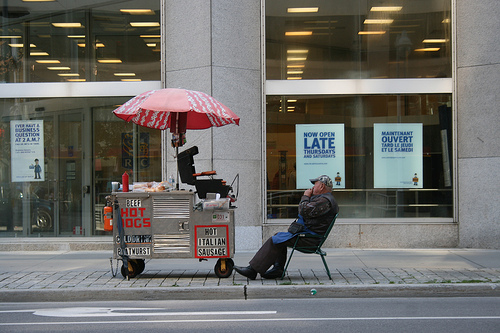
(Photo by tcp909.)

Let’s talk about something near and dear to my heart. Hot dogs. Yep, you know you love ‘em. Whether it be a homemade weiner with kraut from Binkert’s or a dirty water dog sporting mustard and neon-green relish, hot dogs rank pretty high on my favorites list. So it really struck me when I heard Candy Chang talk about one of her many design for change projects, a Street Vendor Guide  for New York City’s ubiquitous food cart vendors. She spoke last Thursday as part of the Mixed Media Lecture series hosted by the Center for Art Education and the MICA Graphic Design department.

Chang describes herself as an artist who wants to make cities more emotional. She is a TED Senior Fellow, a Tulane Urban Innovation Fellow, a World Economic Forum Young Global Leader, and was named a “Live Your Best Life” Local Hero by Oprah Magazine. By combining public art with civic engagement and personal well-being, she has been recognized for exploring new strategies for the design of our cities in order to live our best lives. More of her biography can be found here.

We choose what consumes our hearts. The world becomes more rewarding when you look beyond what you’re searching for. —Candy Chang

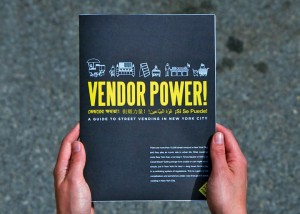
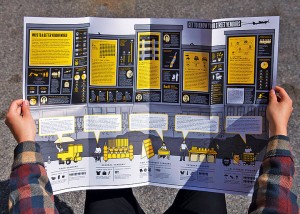
Chang worked with Rosten Woo and John Mangin of the Center for Urban Pedagogy (CUP) and Sean Basinski of The Street Vendor Project to make the Street Vendor Guide an accessible and understandable presentation of important regulations. They found that many vendors were receiving fines of up to $1,000 for small violations that could easily be avoided. Taking a look at the old regulation documents, however, one could easily see how the information was getting lost in translation, often quite literally. Chang designed a new vendor guide that depicts the safety rules and street regulations in easy-to-understand illustrations accompanied by text in Bengali, Arabic, Chinese, English and Spanish. It also includes policy reform recommendations and personal vendor stories. Guides were distributed for free to thousands of street vendors and are available as a download from the CUP’s Making Policy Public site.
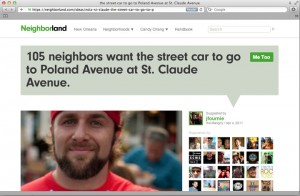
This is just one example of how Chang’s work has shifted a microcosm. Her other work is equally inspiring, crossing the intersections of public art and urban planning, design and communication. One of her more recent projects is Neighborland, an online tool about real places that stemmed from her I Wish This Was public art installations. It promotes community discussion about ways to improve common spaces and connects like-minded citizens with an emphasis on pooling resources. The website encourages residents to speak up about what they want to see change in their city. Prominent street signage encouraged people to also text their ideas to the site, allowing conversations and grass-roots efforts to oscillate between the screen and real world. This unique project is an example of how the gap between the online world and reality can be bridged. I think future efforts to further explore the possibilities of this connection between technology and community will become cutting edge innovations in social change.
I Wish This Was a Successful Protest!

By | Art & Social Change, Of Love and Concrete | No Comments

A newly formed arts cooperative called Brickhaus opened their show “Protest Thru art” in early September.  I can not say that I appreciated much of the work. It gravitated between the extremes of too trite or trying too hard. However, the experience on the whole was powerful. Brickhaus is a raw environment that evokes creativity. Natty Boh flows freely, there is slight odor of humanity mixed with industrial musk, and not a member of the consuming one percent in sight. These are near optimal conditions for an emerging Baltimore artist and a meaningful art show.

That evening there was one work that captured my attention, so much so that in delight I took a piece of it home with me. It was a simple series of 11.5 x 14 inch white paper signs with the words “Future Home of the Contemporary Museum.” The bottom of the page displayed the url http://www.savethecontemporarymuseum.com. It had an adhesive substance on the back. My heist was the exact response the artist wanted.

Baltimore’s Contemporary Musuem of Art closed relatively abruptly this past spring after 22 years in operation. Upon visiting the protest art’s url you realize this under-appreciated institution meant something to the emerging arts community. In protest at the closing, the artist encouraged people to reproduce the sign and post it publicly on properties for rent or just plain vacant. The art was making a statement about an important institution and, just as important, the art made a statement about the developmental desire of the community.

This Baltimore-specific work reminded me of a broad sweeping public art movement that started in 2010 in New Orleans. Public artist Candy Chang recognized a significant supply of vacant properties and a significant demand for those properties to be used. To enhance the efficiency of the market she combined street art with urban planning. She created stickers that said “I wish this was__________”. The community was then invited to use the stickers broadly to define their desires for the blighted property. It was a beautiful work of art. The stickers were an expression in and of themselves, but just as important, they provided a voice to the populace. And oh, by the way, the installation let urban planners know what the “market” wanted.

The success of the installation was so great that many others have followed, and not just with blighted property. The project’s website documents numerous locations and poetic responses. Humanity is amazing! Probably the greatest testament to the art installation’s success is not the replication but the application. Bonafide community planning is now using this simple artistic technique.

Protest art can be productive, particularly when it is voice mixed with positive advancements. I passed along the sign from Brickhaus’ show to an active supporter of the Contemporary. He was moved by the work and quickly passed it along to the board. I am fairly confident the Contemporary will re-emerge in the not so distant future. And this artist protester has been heard!