
Tag

students

Investing in the Leaders of Tomorrow

By | Social Enterprise, The Thagomizer | One Comment

A bad credit history was the only thing keeping the 19-year old James Ward from attending Howard. Ward had been homeless for most of high school but had worked hard and managed to get into a large university. However his mother’s bad credit made him unable to get student loans that would financially enable him to go. So, showing a spark on ingenuity, he found a different way to fund his college education. Ward started a campaign called “Homeless to Howard.” Using only a Tumblr blog and Paypal account he was able to launch an online campaign that helped him raise $12,000, enough for his first year of college.

Access to credit is one of the many “poverty traps” that exist today, mechanisms that create the cycle of poverty and limit inter-generational mobility. Having no credit is just as bad as having bad credit and it is hard to start credit if no-one in your family has good credit. Today, credit can affect your access to everything from an apartment, utilities, cell phones, and as in the example above student loans. Not having credit excludes you from accessing affordable services and loans that allow you to work your way out of poverty.
Luckily new ways of financing are starting to evolve. In the developing world where a student loan system doesn’t exist, microloan systems are coming in to fill the void. Vittana allows people to make $25 loans to students across the world to pay for their education. Graduates make on average 2.8 times more than before and thus there is a 99.8% repayment rate. Two years ago, Kiva, a well known global microlender announced it would start providing small, no-interest loans for student’s education in countries across the globe. Kiva got in the business because they recognize that financing student loans are not appealing to most lending institutions interested only in return. Students have no collateral, require long terms and grace periods, and often have no prior credit history. Making student loans is more appealing to a organization like Kiva where investors are more focused on making social change than getting a financial return.

Lumni, which now operates in the United States asks investors to think of students like start up companies. Through Lumni, investors fund student’s education and those students must promise to give investors back a percentage of the income they make for their first ten years out of college. A deal like Lumni means investors care not only about whether or not the student can pay back the student loans, but how successful they become. They become stakeholders in the student’s future and will do more to make sure they succeed.
student-debt

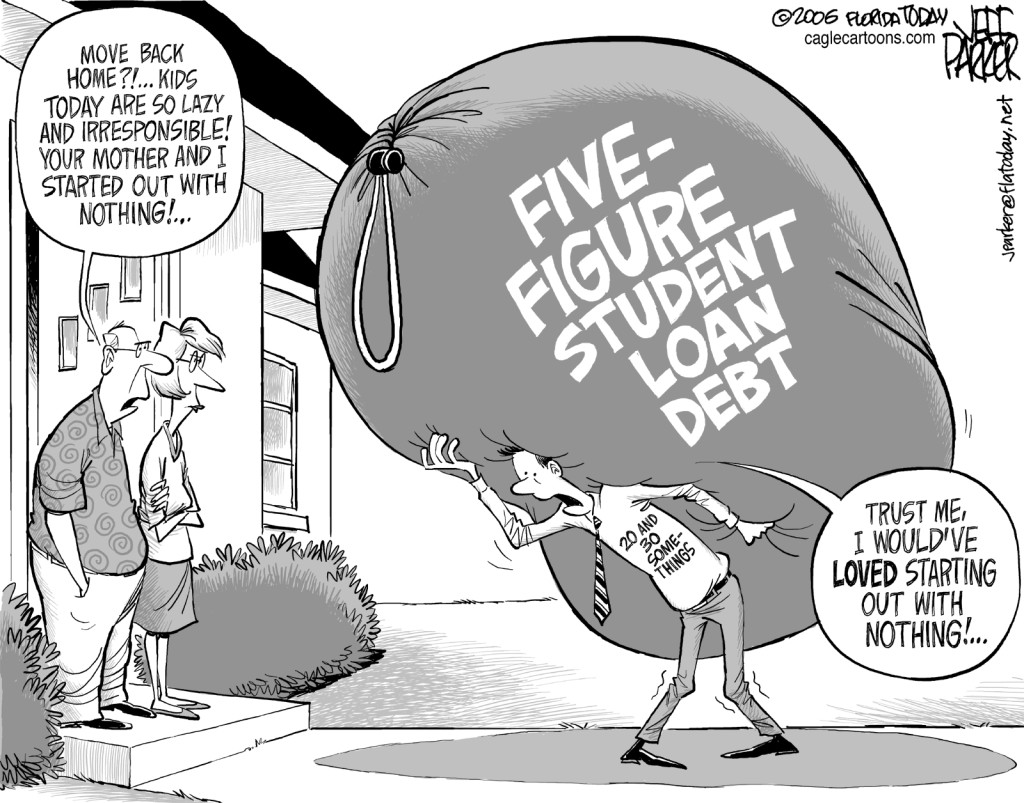
Cartoon by Jeff Parker

American students today leave college with massive amounts of student debts. My generation has seen first hand what happens when you come out of college with loan repayments to make and no good job in site. When faced with a choice of taking a low paying entry-level job at a company that will be an in to your career and a slightly higher paying job at Starbucks, many graduates must chose the latter so that they can start making repayments. Furthermore during their first years, they often shovel so much back into paying off their student loans that they don’t save anything which can cause further financial instability and could result in more debt if any other emergency or need arises.

In contrast a new system, in which loan makers are invested not only in getting a return, but also in student success could not only increase access to funding for education for students like James Ward, but create a system that ensures better success and financial stability for our college graduates. Instead of investing in immediate returns, these social enterprises invest in the future. This allows students to have a grace period to make decisions that will set them up for further success in the long run. It’s a triple bottom line approach that could ultimately lead to larger profits both monetarily and socially for all involved.
Started from the Bottom

By | Health | One Comment

For the past nine months I’ve had the pleasure of working with kids through a nutrition education program called Food as Medicine at a local Baltimore middle school. Twice a week, once after school and once in the 6th grade classroom, volunteers help students think critically about the food they eat and teach them how it affects their body. We’ve had such success in the first year the kids are planning to get a salad bar for the school and have already made a commercial promoting healthy choices (soon to be released on YouTube, it’s a rap to the tune of Drake’s “Started from the Bottom“).

As an AmeriCorps VISTA, you live in poverty and fight poverty through program development and capacity-building. If you know me, you know that I hate using the words “poor” or “poverty” because they create a one-dimensional view in peoples’ minds. Being “poor” doesn’t only mean that you don’t have enough money; it means a much more fundamental lack of resources and opportunity. Yes, the middle school I work at in Waverly is Title I, meaning that about 76 percent of students are low-income and 98 percent of them receive free lunches. But it is the lack of access to society’s institutions and opportunities that creates the true detriment to their health and to their success later in life.

School budgets are determined by enrollment, with schools receiving about $5,000 for each child and a little bit more for special education and advanced students. That is the school’s entire budget that goes to food, toilet paper, teacher’s salaries, projectors and everything else. That leaves little extra for programming or even what many people consider basics. So this school of 6th – 8th grade students cannot afford languages, arts, P.E., health or science education. Aside from our program, the students have no other opportunity for after-school clubs or sports.

Ten years ago, all these students were zoned to Roland Park Middle School, which is one of the best in Baltimore but then were re-zoned to Waverly which didn’t even have a building for these kids to go to. The School Board promised the community a school equal to the quality of Roland Park, but instead gave them an old community center that was scheduled to be shut down and no funding to build it up. The community worked very hard for donations and to get the building suitable for children. Now the building looks nice, but the kids are left with no gym, equipment, playground or drinking water. Want to wash that apple you brought to school for snack? You can, but you will get lead all over it.

So it’s no surprise that these kids don’t know how much sugar is in soda or cereal or even chocolate milk. They don’t know that whole milk, Cheetos and fries have a whole bunch of fat in them. They didn’t know that you can die from strokes, heart attacks and diabetes which all are diseases mostly dependent on diet. Thanks to our program, students can identify what are healthy fats, that hydrogenated oils are bad for you and that too much sugar can cause diabetes. They know why vegetables are healthy and not just that they should eat them. Most importantly, they are more willing to try new foods. Before, students only ate things because they tasted good (and they still do) but now they know how to make healthy choices on their own because we told them how to read food labels and what nutrients are essential, and opened their eyes to all the dirty secrets of processed foods.

Luckily, things are looking up for the Waverly community. They worked very hard to get a brand new $30 million building — the first new school building for Baltimore in 15 years. Next year they will actually have a gym, science labs and enough room to fit 900 kids — more than double the enrollment now. With a building that has safe drinking water they can actually get a salad bar and wash their fruit. They will have an actual kitchen that doesn’t just re-heat food but will be equipped with real cooking utensils. They will have a real gym and a real playground to run around in. With more than double the possibility for funding, they will be able to hire science, health and P.E. teachers and finally will have the resources and opportunities to excel in life.

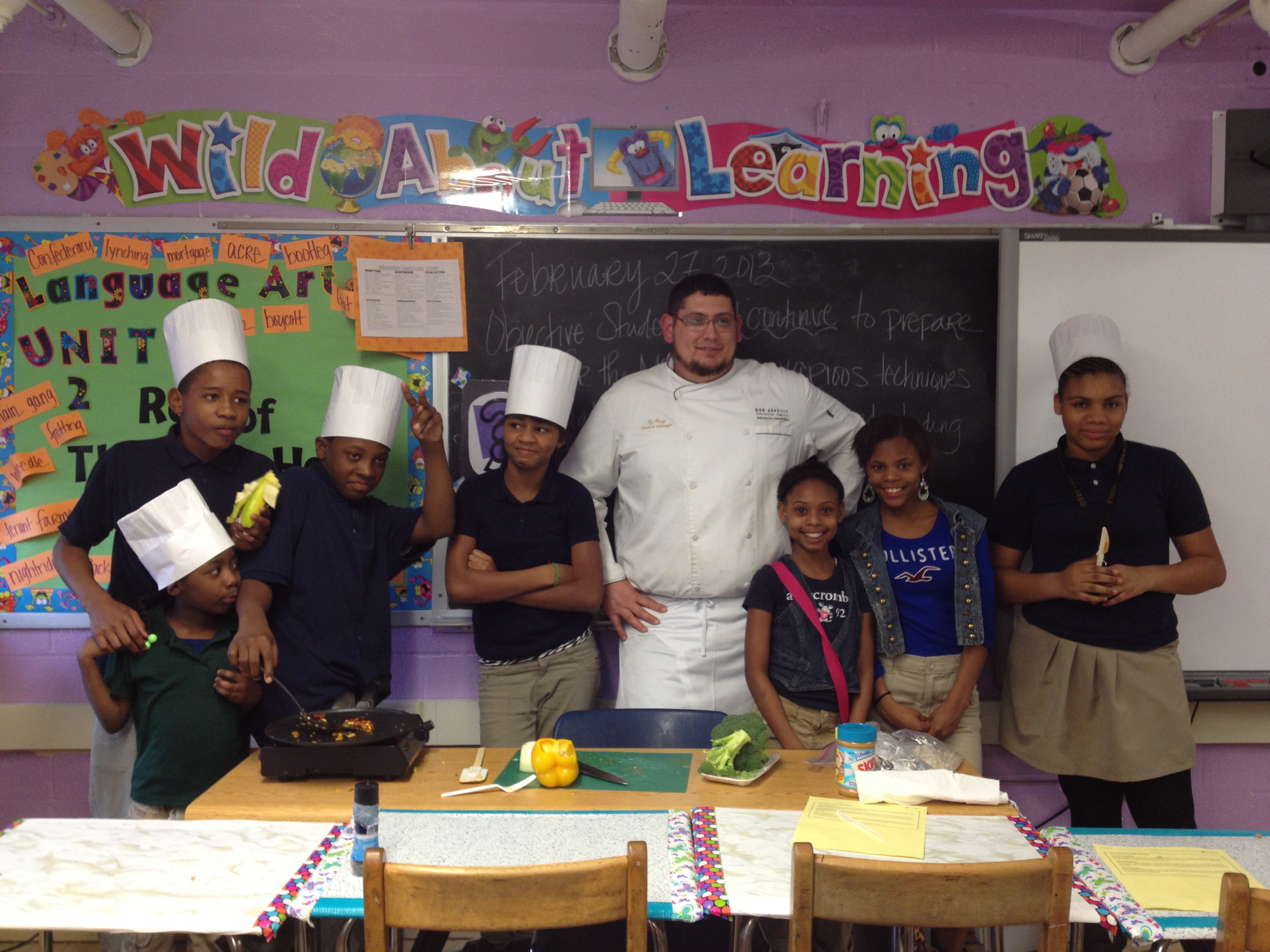
A picture of the after school club, self-named “The Healthy Society,” cooking with Chef Ty from Bon Appetit.