Monday’s issue of JAMA Internal Medicine included results of a survey about American’s perceptions about health interventions and medical practices. Half of all Americans, according to JAMA, believe in one or more medical conspiracy theories, such as the autism/vaccination connection and deliberate, CIA sponsored, HIV infection of African Americans.
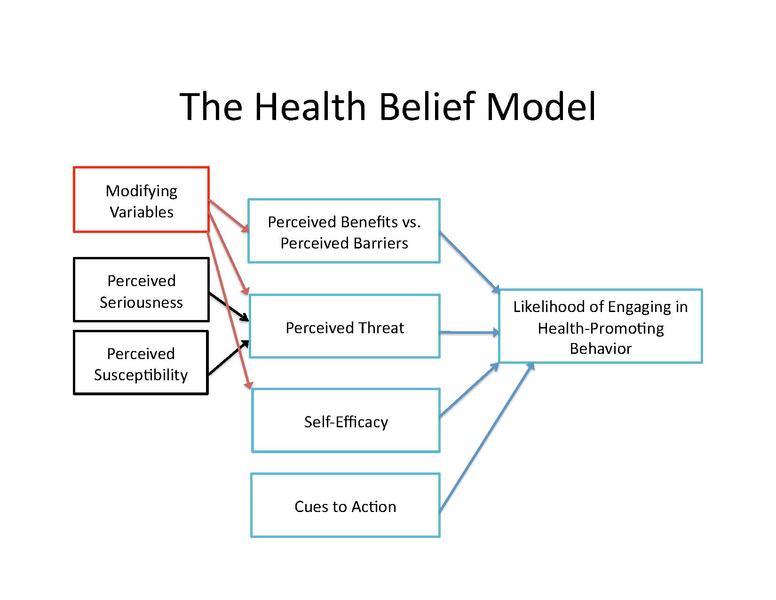
These beliefs are powerful and real examples of the challenges faced by public health workers around the globe as well as here in Baltimore. Beliefs are incredibly hard to shake free once they have taken hold, and no preponderance of evidence will be sufficient to do so, unless a number of other factors come into play as well. This is one of the primary reasons that public health experts emphasize the importance of community involvement in interventions, in building trust and relationships among the families and networks that are targeted for the intervention, and supporting the growth and learning that leads to change.
The Health Belief Model, Wkimedia Commons
A study published in the late 90’s illustrates an example right here in Baltimore, in that case of the perceptions of the benefits of preventative oral health care. Beliefs are often tied to communities, including communities of geography, race, ethnicity, economic status, and gender. Those who are most likely to refuse vaccination, for instance, are likely to be well educated and well-to-do.
The implications for Baltimore are substantial, and tied to our burden of disease. Public health efforts to address the HIV rate among young black gay men, or the rate of narcotic use, or even more socioeconomic health factors such as poverty and nutrition can only succeed if the perceptions of healthy behavior are also addressed.
As all of us who have ever tried to argue with deeply held beliefs will attest, however, people who believe things believe they are true. This is true for all of us. Imagine someone well-meaning and intelligent coming up to you and saying: “Listen, I know you BELIEVE that this gravity thing is a force that pulls you downward, but this is merely a perception that is reinforced by your community. If you listen to this well reasoned argument, then you will be free from this inaccurate belief and thus free to enjoy the benefits of weightlessness, ease of motion, decreased back pain, and splinters in your socks.”
ChangeEngine is a group of public health advocates, whether through advocating for thoughtful design and public planning, creative solutions to aging, the importance of art, the awareness of racial, gender, and socioeconomic divisions. We encourage thoughtful and creative solutions to Baltimore’s challenges, and we challenge our readers to do the same. We must also encourage our ChangeEngine community members to consider and advocate for creative and thoughtful approaches that acknowledge and respect the burdens that belief can impose on community. We must respect that often the greatest barrier to changing ourselves IS ourselves. We need reflect no further than the New Year’s resolutions scattered upon the gym floor to appreciate that this is true.
My suspicion is that Baltimore – or whichever community you live in – reflects the beliefs reported in the JAMA survey. If you have evidence that either supports or contradicts this suspicion, I encourage you to share in our comments sections and on social media. What are our beliefs about how we got to this time and place? What community legends prevent your neighbors from seeking care? What is the consensus among your colleagues about food, health, or wealth? We must first identify the biases of our community before we can leverage that knowledge to effect transformational change.
My wife often makes fun of me for being fat. She is being ironic, as I struggle to maintain a weight above that of a large watermelon, but she enjoys gently poking fun at me, and prefers to do it in a way that is very hard to take too seriously (I am very sensitive).
This personal anecdote is all a segue to the fact that I weigh a little shy of 140 pounds on average. 137 up to 144 depending on my meals. It’s genetic, my father is also a wiry but very skinny man. Anyway, this isn’t actually a post about obesity or healthy weight. I have lately become obsessed with the signs of Baltimore’s commitment to eliminate snow and ice from the road, and Smithsonian tells me that in the United States, 137 pounds of salt are spread on the road PER PERSON! That’s a me’s worth of salt for every person in the country.
It’s different this year in Maryland, of course, since we’ve been on the receiving end of our pal the Polar Vortex and a higher than average number of winter storms. The State Highway Administration has used around 280,000 tons (576,000,000 pounds) of road salt so far this year (which is about what is budgeted for the entire year, by the way, so drive carefully from now on), or about 100 pounds per person. And February is just beginning.
So a pillar of road salt that weighs as much as I do is an interesting concept, but doesn’t really address the confusion/disgust/horror/amazement that hits me every time I walk past a giant pile of salt that seems to have been dropped off the back of the salting truck in case of a very local, very intense blizzard (like maybe fifteen feet of snow, but in a two foot radius). I wasn’t really sure what I was so disturbed about — the run-off of salt water into the bay, the damage to the ecosystem from excessive salinity, the waste of resources evident in the inconsistent salt-spreading operation, the drain on city coffers for treating waste water, salty tap water. All of these vague and uninformed concerns together make observing these urban salt spills a disconcerting experience for me, and so I needed to learn more.
The short answer is that my reactions may be overblown. No one is going to die from salt exposure anytime soon. On the other hand, salt pollution is actually pretty serious in the broader public health context, if you consider environment, biological diversity, and watershed stability.
Researchers at the University of Minnesota determined that a majority of the salt applied to roads stay in the watershed where it is spread, and removal is difficult at best, in addition to being expensive. Fortunately in Baltimore a great deal of salty runoff goes toward the bay, where the salinity will do less harm than in a fresh water environment. Fish populations and plant life in local streams that experience significant road salt runoff are at risk, however, as some freshwater fish cannot tolerate salinity above 1000 mg/liter, 1/20th that of highway runoff.
Clearly, the Jones Falls and other streams in Baltimore City are no longer supporting thriving fish populations, but the overall goals of city planners claim to take stream and tributary health into consideration in the greening and cleaning goals centered on the inner harbor.
Salt will continue to be used, though, especially in winters like this one, for two compelling reasons:
It’s cheap, around $35 a ton. That’s a lot of Adam salty doppelgangers for about the price of three six packs of Resurrection Ale.
It works really well. At least down to a certain temperature. Salt lowers the freezing point of water, but it doesn’t prevent it from freezing altogether, as many of us have seen firsthand with the recent spell of temperatures in the single digits
Despite these advantages, road salt has some significant hazards to health and safety that should cause highway officials to consider moderation rather than excess. In addition to the dangers to fish and plants mentioned above, excess salt buildup (essentially giant salt-licks) on the side of roads can attract deer, heightening the possibility of vehicle/deer accidents causing injury or death to deer and driver alike.
So if roads must continue to be treated in order for driving to be (relatively) safe in B’more, then perhaps alternatives should be investigated. Polk County Wisconsin uses a mixture of traditional road salt and cheese brine. Other localities have had success with other mixtures of salt and locally available ingredients such as beet juice and sugar cane molasses. Baltimore could take advantage of one of many industry cast-offs that could be re-purposed in the interest of public safety. If no other appropriate source could be found, there is always the water from the bay itself. At least runoff of Chesapeake water sprayed on the roads would not cause a net addition of salt to the harbor.
Yesterday, people gathered to honor the legacy of Dr. Martin Luther King Jr. by attending prayer breakfasts and service projects, continuing to forge community through fellowship and action. His image was run in news stories, remembrances and his memorable quotes were posted widely on social media.
This is notable, given that generally people that look like Dr. King are largely absent from news, television and film as anything more than criminals, comedic foils or window dressing. Only this Saturday did SNL debut its first black female cast member in over a decade (alongside two black female writers found during their casting search). Onscreen and in the writer’s room, the voices and talents of black artists are not present to be heard and realized in the final product. This leads to both news and entertainment programs (reflections of how we experience the world) being created by a select group (read: cis white upper or middle class males).
That grand world envisioned by King where one is not judged first by their skin is far from being a reality when the depictions of people of color are forged from the assumptions of whites. When young black girls and young black boys don’t see reflections of themselves onscreen, they internalize the images they do see.
Less than Violent Undereducated Criminal Helpless Unstable
The messages the media bombards us with daily from advertisements to movies imprint on us what the ‘ideal’ is, who can be counted as good and trustworthy and who is to be questioned and regarded with suspicion and distrust.
These stereotypes play out every day in the way media spins stories. Did you see the recent on-field interview with NFL player Richard Sherman? He is being decried for screaming and generally coming off as crazed, but really, he was just riding an intense adrenaline wave. Think about it, not only had he just made the play that would take his team to the SUPER BOWL, but he had just survived a game where no less than four people had to be helped or carried off the field! Wouldn’t you be acting erratic and excitable too?
King’s Legacy itself has been sanitized for public consumption; he has been immortalized as a man of faith working for peace and nonviolence, not as a purported communist that was investigated by the FBI. The March on Washington for Jobs and Justice is widely remembered only as the occasion of the I Have a Dream speech while the larger issues and lists of demands continue to be omitted or pushed to the side because they make people confront uncomfortable truths. Americans are so quick to distill people down to idolized heroes that their essence gets lost in the process. For crying out loud, even the monument to Dr. King in DC is white!
With President Obama’s election in 2008, some have questioned whether America is a post-racial society. The reality remains that we have a long way to go. Until a broader range of the American experience is represented both onscreen and in the writers’ rooms and more people of color are brought on news programs as talking heads and experts, America denies the daily reality of almost 40 percent of her people. When the stories of American life are being written by whites painting blacks and other people of color as the ‘other’ we will all continue to be depicted as stereotypes. This prevents us from being able to start from a blank page and relate first as humans, let alone move forward together as a society.
It is incumbent upon all of us, black or white, to question what we’re being told. Ask yourself why media focused on a drug arrest in the inner city, but not the suburbs; why sitcoms are mostly intra-racial; or why dark skinned people rarely get to be the protagonist. Challenge stereotypes. Question your assumptions. And remember, if you’re not actively working against racism, you are serving the structures that perpetuate it.
This past week or so, the ChangeEngine crew has been debating how to “save” Baltimore. This city, like many others, faces severe challenges, from crippling poverty to crumbling public schools to gun violence and blight. Many of these issues go far beyond the city itself, echoing much larger social and economic trends. The debate rages on as to what can free us from our plight — more bike lanes, get rid of the Baltimore Development Corporation, overhaul the tax structure with a hand grenade. But the truth is that the larger trends are difficult for one individual and maybe even once city to overcome, and that none of them are new.
America’s cities have been afflicted with poverty since the start of the industrialized age. This country has gone through at least four cycles of extreme inequality in that time. Rockefeller and the robber barons, their wealth adjusted for inflation, are still to this day the richest individuals that ever lived. They had more money than the Pharaohs of Egypt, Britain’s Royal Family, and many other historical figures most would consider extraordinarily wealthy and powerful. To give an idea of the wealth these men had: in 1893 the economy crashed, and J.P. Morgan bailed out the government. That’s right — a private individual bailed out the U.S. government. For all the spectacular wealth amassed by private individuals before the most recent financial crisis, it was the government that came to the rescue of J.P. Morgan Chase — the banking leviathan founded by J.P. Morgan himself. The roaring twenties caused inequality to balloon up once again, and the stock market crash of 1929 created another great glut of despair. We are at a similar point now. Not to get all Battlestar Galactica up in here, but “All this has happened before, and all of it will happen again.”
Or perhaps not. It’s true that we are approaching Gilded Age levels of inequality. Our social and economic system has created an enormous disparity in wealth not only between individuals, but also between local municipalities and cities. While “world cities” like San Francisco, Chicago, D.C., New York, and Boston have transformed themselves, rising out of seemingly irreversible chaos and decline in the 1970s and 1980s, others like Detroit, Cleveland, New Orleans, and of course Baltimore are struggling to attract new residents and find employment for those that remain, further perpetuating the crisis. But just because a cycle exists, doesn’t mean we can’t break it. In fact, that same dire history might show the very path to salvation. All hope is not lost. Our wretched circumstances may be just what we need to wake us from our slumber.
True, some of these issues are bigger than Baltimore and need bigger solutions. But many of those larger solutions can start right here at home. More democracy, accountability and participation can save Baltimore, and might just save us all.
It’s that holiday season again: that special time of year when families come together to … buy all the things. It’s the time of year when toy advertising just goes bananas. Every toy brand is vying to be that one must-have toy this year, and their advertising is kicking into high gear. GoldieBlox, Inc. is one such company, intent on disrupting the toy scene with a new line toys for girls (pink! ribbons!) designed to spark their interest in engineering.
They were quite successful in creating buzz for their toys, in part because of the growing interest in getting girls into engineering, but mostly because of their really awesome ad.
The ad included a new version of the Beastie Boys song “Girls”, with new music played on toy xylophones and some switched up lyrics sung by girls complaining about the lack of non-pink, non-doll toys for girls. Unfortunately, GoldieBlox didn’t get permission from the Beastie Boys to use their song, and the Beastie Boys didn’t really appreciate that. Thus was born an internet copyright controversy.
There’s been a lot of misinformation and misunderstanding of the law floating around on Twitter, blogs, and even in the mainstream media about this issue. I’d like to clear some of it up. I’ll cover the main issues here, but if you have any more questions, I’m happy to answer them in the comments.
**First, let’s all get on the same page on the basics. So, what is copyright?**
Copyright is a right granted generally in the US by the Constitution, and specifically laid out in law passed by Congress. Copyright is designed to promote the creation of artistic and creative works by giving creators a way to make money off of their creations, granting a legal monopoly to creators of work that gives them exclusive rights to use, display, copy, etc. the work for a “limited” amount of time. To qualify for copyright protection, the work must be original, minimally creative, and “fixed in a tangible medium of expression.” There’s nothing that you have to do to get copyright protection for a qualifying work. It just magically happens. Draw a doodle on a napkin? Poof. Copyrighted. Write a haiku in a tweet? Shazam. Copyrighted.
Copyright grants ownership over an expression of an idea. “Hang on,” you might be thinking, “I thought we had a little something called freedom of expression in this country!” And right you are. In order to balance the ownership of expression granted by copyright and the freedom of expression guaranteed by the First Amendment of the Constitution, courts, and later Congress, have carved out an exception to copyright ownership: the Fair Use Doctrine.
Courts look at several factors in a case of alleged copyright infringement to determine if the unauthorized use of the copyrighted work qualifies for the exception. No one of these is in itself determinative. They will also be evaluated slightly differently in different courts around the country. The way our federal legal system works means that the same set of facts might be looked at slightly differently in a court in California and one in Massachusetts.
**Now that we’ve covered the basics of the law, let’s apply it to this GoldieBlox/Beastie Boys situation.**
The first question is always whether there’s a copyrighted work. The Beastie Boys’ song “Girls” was recorded, which counts as fixation in a tangible medium of expression. Check. I’m going to vouch for it being minimally creative. Check. Lastly, it is also original. A lot of the Beastie Boys’ music contains direct samples from other songs. The melody for “Girls” seems to be quite similar to the melody of Bo Diddley’s “I’m All Right”. But it is important to note that the use of direct samples, or the use of similar melody lines does not negate the originality of the work as a whole. Even songs or DJ tracks that contain only already existing songs can still be original as a whole. So, as a whole, “Girls” is original. Check. The song is copyrightable, and copyrighted.
Second question: was there an unauthorized use of the copyrighted work? Copyright gives a “bundle of rights” to the creator. One of these is the right to make derivative works, which is what happened here. The version of “Girls” that GoldieBlox made was based on the Beastie Boys’ version, but with different words, and rerecorded music. The creation of the derivative work was not authorized, which is pretty clear from the open letter to GoldieBlox from Ad-Rock and Mike D.
We’ve established the potential for copyright infringement, now let’s look at fair use.
**Can a commercial use be fair use?**
A lot of people have fixated on the fact that GoldieBlox used the song in a commercial, and declared that fair use does not apply. But that hasn’t been the law since the 1994 Supreme Court case Campbell v. Acuff-Rose. This is one of those cases that makes me really like practicing law. In Campbell, the U.S. Supreme Court looked at th issue of whether the 2 Live Crew version of “Pretty Woman” was fair use of Roy Orbison’s original “Oh, Pretty Woman”. Yep. The lyrics to a 2 Live Crew song have been carefully analyzed and immortalized in a Supreme Court decision.
In Campbell, the Supreme Court rejected the old bright line rule that said a commercial use of a copyrighted work automatically wasn’t fair use. Instead, they ruled that commercial use on its own wasn’t enough to throw the possibility of fair use out the window.
**What about the Parody exception?**
Fair use protects people’s free speech rights to create parody works without permission from the original artists. Many people have decided that the GoldieBlox version of “Girls” was a parody, and therefore protected by fair use. I disagree.
In fair use law, there is a distinction made between parody and satire. Parody is protected by fair use, satire is not. The difference is (according to judges) that parody is a use that makes fun of the original work, and satire makes fun of some outside thing. The reasoning is that when creating a parody, the creator won’t be able to express what they want to express without using the original work, and since the new work makes fun of the original work, the copyright owner is unlikely to license it. So, in order to not infringe on the parody creator’s free speech rights, the courts have to make an exception to the copyright owner’s right to control the use of their work. On the other hand, satire is just a convenient use of an existing copyrighted work to make fun of something else.
The Supreme Court decided the Campbell case largely on the parody issue. They found that the 2 Live Crew version of “Pretty Woman” was making fun of the original version, and therefore was a fair use parody. In the case of the GoldieBlox version of “Girls”, some people have said that it is a parody making fun of the original Beastie Boys version of the song and their attitude towards women as expressed in the song. If you look at the lyrics to the GoldieBlox version however, it is pretty clear that it is targeted at making a comment on the state of the toy industry and marketing towards girls, and not targeted at making a point about the Beastie Boys song itself. So, I don’t think that the parody exception applies in this case.
**Isn’t this kind of stupid?**
Yes. This is absolutely stupid. My personal opinion on the parody/ satire distinction in copyright law is that it is an artificial distinction created by judges, and doesn’t really make any real world sense. If GoldieBlox wanted to take this case on up to the Supreme Court and argue that fair use should apply even though it is arguably not a parody, I would be all for it. The biggest problem with the parody/satire distinction is that it is really easy to shape the facts of any particular case to make it seem like parody or like satire. In fact, in Suntrust v. Houghton Mifflin (a reinterpretation of the novel “Gone with the Wind” from the slaves’ perspective) two courts looked at the same exact facts and one found the use to be satire, one to be parody. The distinction between parody and satire is hard for courts to apply consistently, and nearly impossible for creators of derivative works to predict. The dichotomy itself creates a chilling effect on free speech.
All in all, I think that GoldieBlox version of “Girls” should be considered fair use, but under current law, I don’t think it falls under the parody exception and wouldn’t be considered fair use.
**Why did GoldieBlox sue the Beastie Boys and not the other way around?**
One interesting twist to this controversy is that even though GoldieBlox was the one accused of infringing the copyright, they sued the Beastie Boys. This is pretty normal in situations like this, and is just a legal procedural issue. What GoldieBlox did is ask the court to look at the facts and make a declaratory judgement that GoldieBlox was not infringing on the Beastie Boys’ copyright. This is actually a really helpful thing for people involved in copyright disputes. If someone accuses you of copyright infringement and threatens to sue, say, in an open letter on the internet, you can just go straight to court and get it sorted out — you don’t have to wait around for them to sue you. This is also why if you threaten to sue someone in writing, you’d better really mean it.
**Has this all been resolved now?**
It looks like it. GoldieBlox has pulled the offending ad and apologized. I think this is a smart thing for them to do. When you’re facing a lawsuit, it’s important to really evaluate what your objectives are. Sometimes, an artist will be willing to risk a lot to stand up for their right to create their art. But sometimes it just comes down to money. Even if you win, a copyright lawsuit might drag on for a long time, and cost a ton of money. My guess is that GoldieBlox’s objective with their “Girls” version was just advertising. Mission accomplished on that front. There’s no real reason for them to keep fighting if they don’t have to.
**What about about Adam Yauch’s will?**
One of the Beastie Boys, Adam Yauch, passed away in 2012 and included in his will the direction that none of his artistic works be used in advertisements in any way. Whether or not this is actually enforceable is a whole other can of worms, so I won’t get into it here. But even if it is enforceable generally, it doesn’t actually come in to play in the question of fair use. A creator of a copyrighted work can put all sorts of restrictions on licensing in their will, but that will not touch on other creators’ freedom of expression-backed rights under the fair use doctrine. But from a PR perspective, going against the wishes of one of the original creators of the work was not a good move for GoldieBlox, and was ultimately the reason they gave for pulling the ad.
**So what does this mean for me?**
The most important thing to learn from this is that there are few bright line rules when it comes to fair use. Using a copyrighted work in a non-commercial way, or being a non-commercial or nonprofit organization won’t automatically get you fair use protection. The commercial impact of the supposed fair use is definitely taken into account, but it is only one piece of the puzzle. You’ll have a slightly better case if it is a non-commercial use, but it isn’t enough of a difference, in my opinion, to count on that to protect you. Honestly, I think a bigger factor than the legal issue is the potential for bad PR from a copyright holder if they sue some poor nonprofit.
Copyright law, and the fair use doctrine in particular, can be pretty tricky. There are multitudes of factors to be looked at for different situations and claims, and they may be looked at differently by different courts around the country. There’s no surefire way to predict what a court will decide on these issues, but the closest you can get is to talk to a good attorney beforehand.
Most lawyers will tell you that the only way to make sure you’re not infringing someone’s copyright is to not use anyone’s copyrighted work in your work. That may be true, but it’s no way to live. If you find yourself in a situation where you want to use someone’s copyrighted work in a way that you think is fair use, talk to an attorney that is willing to work with you to find the safest way to go about doing it. If you’re worried about money, still give an attorney a call. Many attorneys will listen to what your issue is and will be able to give you an estimate of what it will cost for them to research it and advise you. It may be cheaper than you think. Also, many communities have organizations of volunteer lawyers for the arts, who will give free or low cost consultations to artists on copyright, trademark and many business issues.
This is not, and should not be taken as, legal advice. If you want legal advice, please hire a lawyer.
This idea has sparked a great deal of debate here in the states, setting the tongues of the chattering classes a-wagging with equal parts indignation and inspiration. Many dismiss the idea as impractical, madness. But the question that needs to be asked is, if the Swiss can do it, why can’t America — the richest and most powerful country in human history? And whether, given the way our economic system works now, we might not be the ones who are crazy.
Meet Jake
But don’t we already have welfare for those in need? Work harder and you will get somewhere, goes the American mantra. Well, lets take a hard look at the welfare system … Meet Jake, a 25 year old male with no dependents. Jake has a job working at Walmart. Luckily enough, he gets to work 40 hours a week at minimum wage. Unlike some of his colleagues, he earns $13,920 a year pre-tax in the state of Maryland. Between the current benefit programs, which include SNAP (Supplemental Nutrition Assistance Program), EITC (Earned Income Tax Credit), and Section 8 housing credits, Jake receives about $590 a month. If Jake wasn’t eligible for Medicaid, which in Maryland he would be, another $180 a month from the Affordable Care Act would come his way to get health insurance. Jake would only get a few hundred bucks extra under the Basic Income plan. And a large number of these programs are means-tested; creating a perverse incentive for those most in need — the less poor you get, however incrementally, the worse off you are. By supplying a basic income, work would actually pay off for Jake, and he would have a reason to strive for better pay and advancement.
But the problem of welfare isn’t just the amount of money but the message that’s sent in how it’s distributed. Stores that accept SNAP benefits have large signs stating what they can and can’t be used for. No hot food, no prepared food, no booze or tobacco. So on SNAP Jake can’t head to the deli counter and get a hoagie to-go or some of Eddie’s Mac and Cheese to share with his kids for dinner. The system assumes that the poorer you are the worse your choices will be, which is being proven wrong in many countries around the globe. The fact of the matter is that cash payments, with little to no strings attached, work. A majority of recipients in such programs spend the money on fixing their house, better food, expanding or creating small businesses, and their education.
Try to do any of this under the current regime, and Jake will get a rude awakening. Section 8 housing vouchers, while they are supposed to be universally accepted, are often refused by landlords. That is assuming you are getting them in the first place because the process for those benefits can take months or years. SNAP benefits need to be reapplied for every six months and don’t you forget! Because if you do you are going to spend at minimum a whole day down at the welfare office getting it straightened out. How is someone working hourly on minimum wage, who has kids or has to go to school supposed to do this? The amount of red tape is astounding. Think of how much energy would be saved — and unleashed — by simply replacing all of this with a basic income.
Free Money and The Protestant Ethic
“But it is still free money and why would you work if you get free money? We will all get lazy!” yells my inner economist. But what if I told you that wasn’t the case? When Canada ran an experiment in the town of Minocome, productivity and work rates only dropped by 1 percent on average. The groups that dropped the most were new mothers and teenagers supporting their families. The mothers spent more time with their children and the teens spent time in school. That sounds like a win-win to me. Our friend Jake could go back to school part-time to become a carpenter, finish his GED, or gain other skills. American productivity levels are off the charts, while the share of profits for most Americans has declined. It is about time the American Worker got their fair cut of the pie.
The best part is that a basic income is financially doable. All we need is the political will. Jake would no longer have to cut through red tape to try to make a better life for himself. Every American would get a bigger cut of the productivity they already put into the system. The cash payouts would empower renters to become homeowners, single mothers to spend more time with their children, and give young adults in this struggling economy the security to start their own business. A basic income could be the fuel that allows America to thrive in the 21st century.
I shy away from criticizing Obamacare too much because I think it provides some major improvements to our health care system. Personally, the law has positively impacted me — more free preventative care, more services covered and longer coverage. But lately I’ve become a bit fed up with my own health insurance and doctors’ visits, and it’s hard not to ignore all the negativity surrounding the law. Obamacare isn’t the problem here. It’s definitely not the solution either. Rather, Obamacare is kind of like a band-aid that distracts you from the real problem — a health care system that perpetuates inequality.
Ironically, this past year I met a lot of bright-eyed Johns Hopkins students who came to be a part of the “best” health care system in the world. And our medical education is arguably the best in the world (thanks to the 1910 Flexner Report that set Johns Hopkins Medical School as the gold standard for medical education and compared all other schools to it.) There’s no doubt our doctors can do amazing things. A news report stated that a Chicago suburban hospital has a 97% survival rate for gunshot wounds that enter the ER. Considering that a bullet can enter your upper torso and exit in your lower torso, damaging every organ in between, that is a spectacular rate. It’s the long-term care after the fact where we drop the ball.
Here’s an all-too-typical story: a patient is admitted to the hospital, can’t get out of bed for weeks on end and when it’s time to leave, they no longer have the strength to walk. Patients lie in their hospital bed for weeks eating crappy hospital food and their only option for exercise is to be the creepy person walking up and down the hallway in their hospital gown dragging the IV stand. Healthcare in the United States is amazing at the quick-fix, but when it comes to helping a patient overcome root causes of illness, we don’t really try. There’s rarely any sufficient patient education or measures taken to prevent re-admittance to the hospital.
What’s even worse is what can come after the hospital — a nursing home. No one wants to be in one. Not even the workers like being there. If you can’t afford at-home help, off you go to spend most of your time eating more crappy food and watching more TV in bed.
Patients at all hospitals should be receiving holistic care. Take the New York program that allows doctors to prescribe vegetables, for instance. Instead, many patients are being subjected to a long-standing though theoretically taboo practice called “patient dumping” where patients at one health facility are forced to another, usually because of their insurance status. Though hospitals are required to treat whoever enters their doors under the Emergency Medical Treatment and Active Labor Act of 1986, patient dumping still occurs, even as horrible as busing people to another state.
Soon about 30 million more people will have health insurance, but it’s scary to think that “patient dumping” might still occur even if the majority of Americans are insured. Will you be referred to a crappier facility if you have the cheapest health insurance? That’s the thing with our health care system — if you have more money, you receive better and faster care. There will be minimum benefits thanks to Obamacare, but people with more money will still be able to afford better health insurance even with the “Cadillac” tax for the more exhaustive insurance plans. In Germany, health insurance will cover spa days and yoga if your doctor prescribes it. Why can’t everyone have benefits that would get a “Cadillac” tax? If only we could take a step back and realize the care we’ve been delivering is actually not the best in the world, then maybe we could start on the path to the equal holistic care we all need and deserve.